

Unveiling the Breakthrough Can-Opener Effect in Nanomaterials
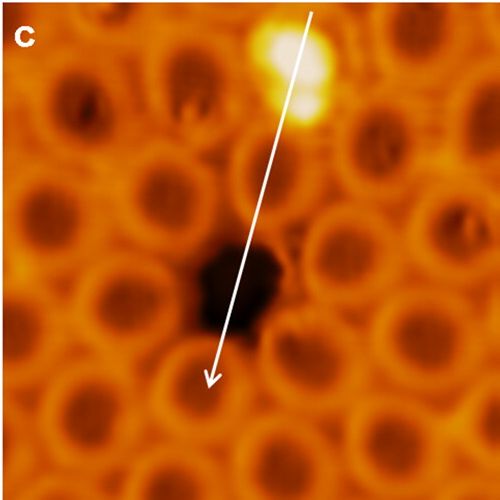
Scanning tunneling microscopy image (14×14 nm2) showing the surface after the can-opener effect. The dark 2 nm-hole at the centre is a pore site of the h-BN super-honeycomb (nanomesh), which is cut out. The “lid” of the “can” is found nearby as a bright flake. From Cun et al., NanoLetters 13, 2098 (2013) (article).
Discoveries by the University of Zurich’s Surface Physics Group
Explore fascinating data revealing groundbreaking scientific findings and innovations.
2
Nanopore Formation
Detailing the creation of 2 nm-sized holes in single-layer h-BN through ion exposure and annealing.
5
Material Functionalization
Exploring the potential for modifying sp2-hybridized sheets of h-BN and graphene using the can-opener effect.
8
Research Impact
Highlighting the breakthrough implications of nanometer-scale modifications in 2D materials.
Unveiling Nanometer-Scale Holes with Low-Energy Ion Exposure
Discover groundbreaking research illuminating the can-opener effect in 2D materials.

Fundamentals of the Can-Opener Effect
Understand how ion exposure creates nanoscale patterns in h-BN and graphene.

Applications and Implications
Investigate potential uses for nanostructured 2D sheets in technology.

Research Insights
Dive into detailed studies revealing the physics behind the effect.